
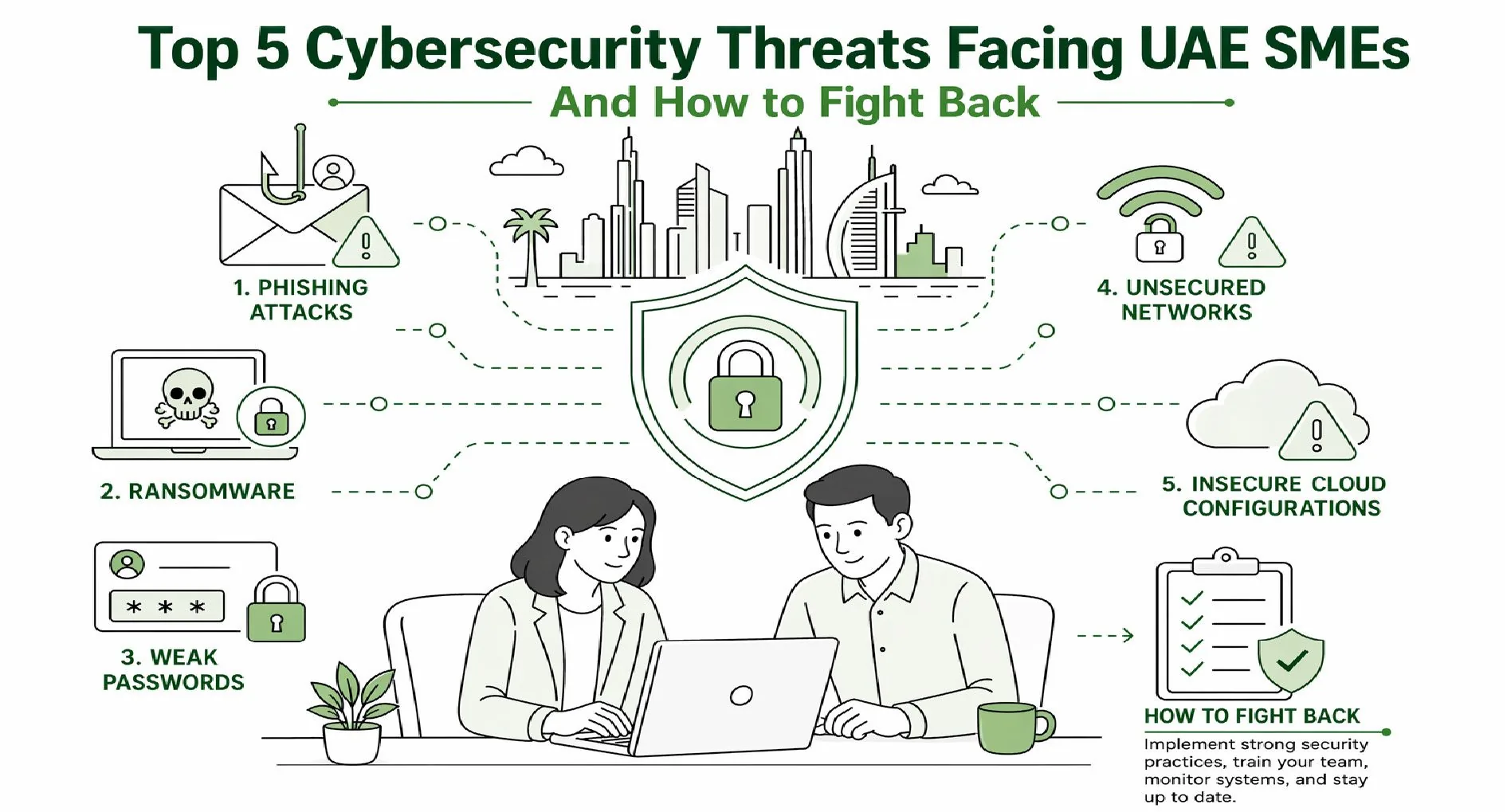
Why Are SMEs Being Targeted?
There is a common misconception that hackers only go after big corporations. The reality is the opposite. Small and mid-size businesses are the easiest targets because they typically have:
- Smaller security budgets
- Fewer (or no) dedicated IT security staff
- Outdated software and systems
- Less employee awareness about cyber threats
In the UAE, where SMEs make up over 94% of all companies and contribute significantly to the economy, this creates a massive opportunity for attackers.
Let us look at the five biggest threats — and what you can do about each one.
1. Phishing Attacks
What It Is
Phishing is when an attacker sends a fake email, SMS, or message that looks like it comes from a trusted source — your bank, a government agency, a supplier, or even your own CEO. The goal is to trick you into:
- Clicking a malicious link
- Downloading an infected file
- Entering your login credentials on a fake website
Why It Hits UAE Businesses Hard
- The UAE's multilingual workforce means phishing emails come in English, Arabic, Hindi, Urdu, and more
- Business email compromise (BEC) — where attackers impersonate a company executive to authorize fake wire transfers — has cost UAE companies millions of dirhams
- During peak business seasons (Ramadan promotions, year-end deadlines), employees are busier and more likely to click without thinking
How to Fight Back
- Train your staff — run regular phishing simulations so employees learn to spot suspicious emails
- Enable multi-factor authentication (MFA) on all email accounts and critical systems
- Use email filtering tools that flag suspicious senders and links
- Verify payment requests by phone before transferring money, especially if the request came by email
2. Ransomware
What It Is
Ransomware is malicious software that locks all your files and demands payment (usually in cryptocurrency) to unlock them. Modern ransomware gangs also steal your data first and threaten to publish it if you do not pay — this is called "double extortion."
Why It Hits UAE Businesses Hard
- The UAE's position as a financial and trade hub makes its businesses high-value targets
- Many SMEs run on a single server or a few workstations — if those get locked, the entire business stops
- Companies that cannot afford downtime are more likely to pay the ransom, which funds more attacks
How to Fight Back
- Back up your data regularly — and store backups offline or in a separate cloud account that ransomware cannot reach
- Keep all software updated — ransomware often exploits known vulnerabilities in outdated systems
- Use endpoint protection (modern antivirus) on every device connected to your network
- Segment your network — if one computer gets infected, it should not be able to spread to everything else
- Have an incident response plan — know exactly what to do in the first hour after an attack
3. Cloud Misconfiguration
What It Is
As more UAE businesses move to cloud services (AWS, Azure, Google Cloud, or local providers), incorrect security settings become a major risk. Common mistakes include:
- Leaving storage buckets (like AWS S3) open to the public
- Not enabling encryption for data at rest
- Using default passwords on cloud admin panels
- Granting too many users admin-level access
Why It Hits UAE Businesses Hard
- The UAE government is actively pushing digital transformation, which means rapid cloud adoption
- Many SMEs migrate to the cloud without a security review — they focus on getting things working, not on locking things down
- A single misconfigured setting can expose thousands of customer records to the open internet
How to Fight Back
- Run a cloud security audit before going live — and repeat it quarterly
- Follow the principle of least privilege — give each user only the access they need, nothing more
- Enable logging and monitoring so you can detect unauthorized access quickly
- Use cloud security posture management (CSPM) tools that automatically scan for misconfigurations
- Encrypt everything — data in transit and data at rest
4. Insider Threats
What It Is
Not all threats come from outside. Insider threats come from people within your organization — employees, contractors, or business partners — who either:
- Intentionally steal data, sabotage systems, or sell access to outsiders
- Accidentally cause a breach by making a mistake (sending sensitive data to the wrong email, losing a laptop, using weak passwords)
Why It Hits UAE Businesses Hard
- The UAE has a highly mobile workforce — employees change jobs frequently, and departing staff may take data with them
- Many SMEs rely on contractors and freelancers who have access to internal systems but may not follow the same security practices
- Family-run businesses sometimes share login credentials across multiple people for convenience
How to Fight Back
- Implement access controls — every employee should have their own account with appropriate permissions
- Monitor user activity on sensitive systems (file servers, financial software, CRM)
- Revoke access immediately when someone leaves the company
- Conduct background checks for roles that handle sensitive data
- Create a clear data handling policy and make sure everyone signs it
5. Supply Chain Attacks
What It Is
A supply chain attack happens when hackers compromise a vendor or software provider to gain access to their customers. Instead of attacking you directly, they attack someone you trust — and use that trust to get in.
Why It Hits UAE Businesses Hard
- UAE businesses are deeply connected to global supply chains — logistics, finance, retail, and construction all depend on third-party vendors
- Many companies use shared software platforms for accounting, HR, or project management — if one of those platforms gets compromised, every customer is affected
- SMEs rarely assess the security posture of their vendors before signing contracts
How to Fight Back
- Evaluate vendor security — ask suppliers about their security certifications (ISO 27001, SOC 2) before signing contracts
- Limit vendor access — third-party providers should only access the specific systems they need
- Monitor third-party connections to your network
- Include security requirements in vendor contracts
- Keep an inventory of all software and services your business uses — you cannot protect what you do not know about
The Bigger Picture: Build a Security Culture
Technology alone will not protect your business. The most effective defence is a security-first culture where every employee understands:
- Why security matters
- What threats look like
- What to do when something feels wrong
This does not require a massive budget. It requires awareness, consistency, and the right guidance.
How Underwings Can Help
We work with UAE SMEs every day to identify vulnerabilities, train teams, and build defences that actually work. Our services include:
- Vulnerability Assessment & Penetration Testing (VAPT) — we find the holes before attackers do
- Security Awareness Training — practical, engaging sessions for your team
- Security Audits — a full review of your current security posture
- Incident Response Planning — so you are ready when (not if) something happens
Do not wait for an attack to take security seriously. Talk to us today.
