
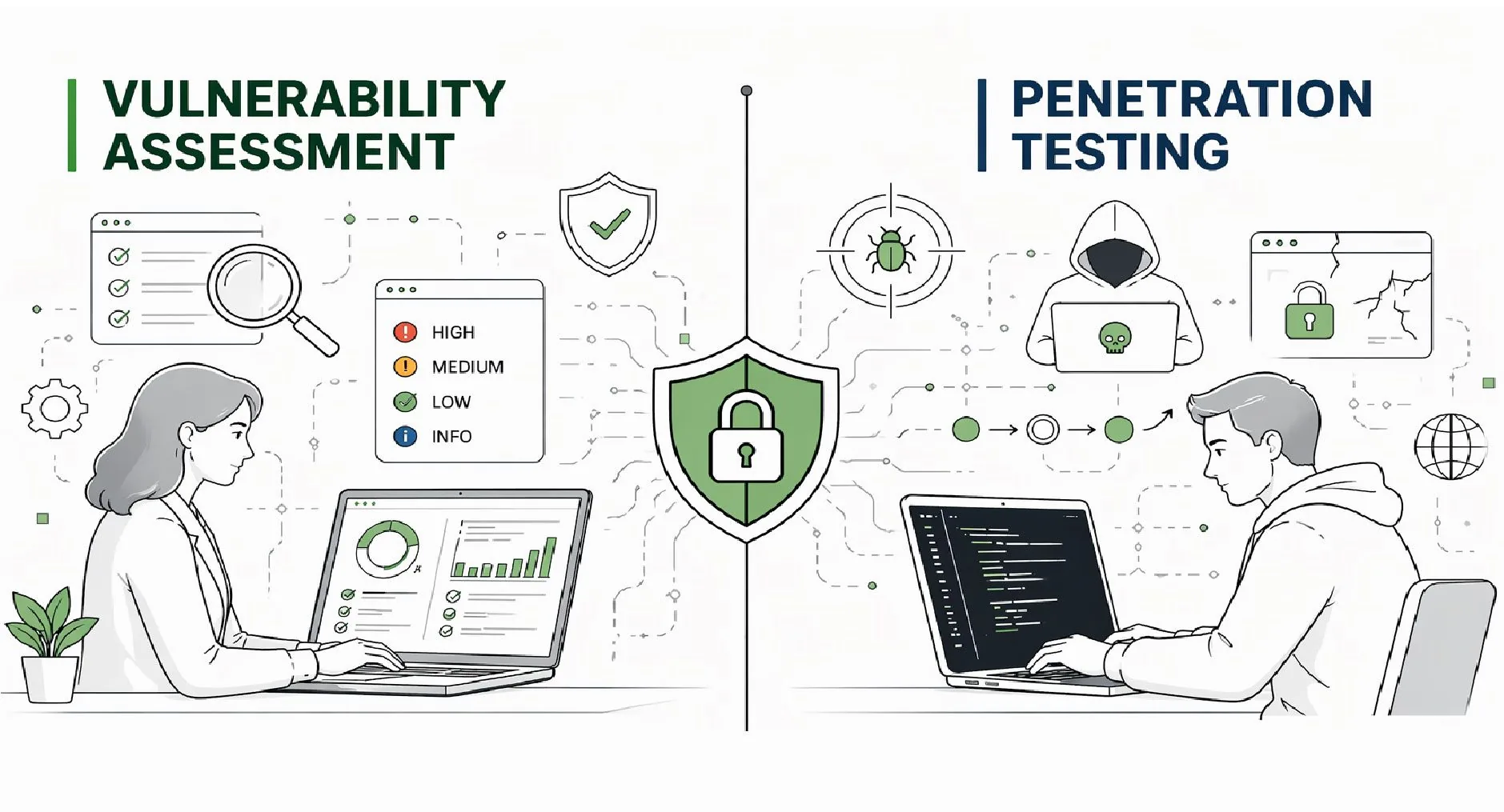
Two Services, Often Confused
A UAE client asks for a "security test." Some want a penetration test. Some want a vulnerability assessment. Most can't tell the difference — and neither can their vendors, half the time.
The difference matters. One produces a scan report; the other produces evidence of real-world exploitability. One costs AED 5,000; the other AED 20,000 – 60,000. One satisfies a PCI DSS quarterly scan; the other satisfies an ISO 27001 or enterprise procurement demand.
Here's the plain-English breakdown.
What a Vulnerability Assessment Actually Is
A Vulnerability Assessment (VA) is a breadth-first, scan-based inventory of known vulnerabilities. Tools like Nessus, OpenVAS, Nuclei, and Qualys run automated checks against your targets and produce a list of findings with CVSS scores.
- Goal: Catalogue known vulnerabilities.
- Method: Automated scanning, with manual validation of criticals.
- Depth: Shallow — checks for known patterns, doesn't attempt exploitation.
- Output: Findings report with CVSS scores and remediation guidance.
- Typical cost (UAE): AED 5,000 – 15,000 per engagement.
- Typical duration: 2 – 5 working days end-to-end.
VA is the right choice when:
- You're an SME doing your first formal security assessment
- You need PCI DSS quarterly external scan evidence
- You need a cheap, recurring baseline of known-issue exposure
- Your budget can't stretch to a full pen test
What a Penetration Test Actually Is
A Penetration Test is a depth-first, manual attack simulation by a credentialed offensive-security practitioner. The tester starts where scanners stop: chaining findings together, escalating privileges, moving laterally, and demonstrating the actual business impact of weaknesses.
- Goal: Find real-world paths an attacker could exploit.
- Method: Manual, exploit-driven, context-aware testing.
- Depth: Deep — scanners are tools; the testing is human.
- Output: Findings report with reproduction steps, business impact, and remediation walkthrough.
- Typical cost (UAE): AED 15,000 – 60,000 depending on scope.
- Typical duration: 2 – 3 weeks including scoping, testing, reporting, walkthrough.
Pen testing is the right choice when:
- An enterprise client or bank has asked for a pen-test report
- You're preparing for ISO 27001, SOC 2, PCI DSS, or NESA audit
- You've recently deployed significant infrastructure or application changes
- The board or CISO has asked what an attacker would actually find
The Critical Difference
A scanner finds: "Apache 2.4.41 is installed; CVE-2021-42013 exists."
A pen tester finds: "Apache 2.4.41 is installed; the CVE is exploitable in your configuration; I used it to gain shell access; I pivoted to your internal network; I captured credentials from the domain controller; here's the forest root I achieved in 4 hours."
Both findings might score the same CVSS. Only one is useful to an auditor asking for evidence of exploitability.
Which Satisfies Your Compliance Requirement?
- PCI DSS quarterly external scan: VA only. ASV-authorised scanner sufficient.
- PCI DSS annual penetration test: Pen test required. Specifically called out in the standard.
- ISO 27001 Annex A.8.8: Pen test preferred; VA alone usually insufficient for certification auditor.
- NESA / UAE IA V2 technical controls: Pen test preferred; VA as evidence of continuous scanning.
- PDPL: Neither explicitly required, but pen test highly recommended for data-handling systems.
- SOC 2: Pen test effectively mandatory for the trust services criteria.
- Enterprise procurement pen-test demand: Pen test, always. VA alone doesn't pass procurement review.
The Bundling Question
Many UAE mid-market organisations end up needing both over time:
- Annual pen test (mandatory for compliance, deep assurance)
- Quarterly VA (continuous monitoring, cheap coverage, satisfies ongoing-scan requirements)
Most of our pen-test clients add a recurring VA retainer after the first engagement — AED 5,000 – 12,000 per quarter for standing coverage.
The "Which Do I Actually Need" Decision Tree
- Starting from zero, no specific compliance driver? VA first. Get the baseline, fix the obvious. Upgrade to pen test when the scope or client demand justifies it.
- Compliance driver (ISO 27001, SOC 2, PCI DSS, enterprise client contract)? Pen test. Non-negotiable.
- Recurring cheap coverage needed? VA on retainer, plus annual pen test.
- Had an incident? Pen test. You need to know what the attacker could have done beyond what they did.
What We Recommend Day-1
For UAE SMEs (10 – 50 employees) with no formal security posture, we typically recommend:
- Vulnerability Assessment to set the baseline (1 week, AED 5,000 – 10,000)
- Fix the top 10 critical/high findings (2 – 4 weeks, your IT team)
- Web Application Penetration Testing if customer-facing web surface (3 weeks, AED 15,000 – 25,000)
- Or Network Penetration Testing if the exposure is more infrastructure than app (3 weeks, AED 20,000 – 40,000)
Total first-year offensive-security spend: AED 25,000 – 50,000 for a serious, defensible program.
Not sure which one you need? 30-minute scoping call, we'll tell you honestly.
