
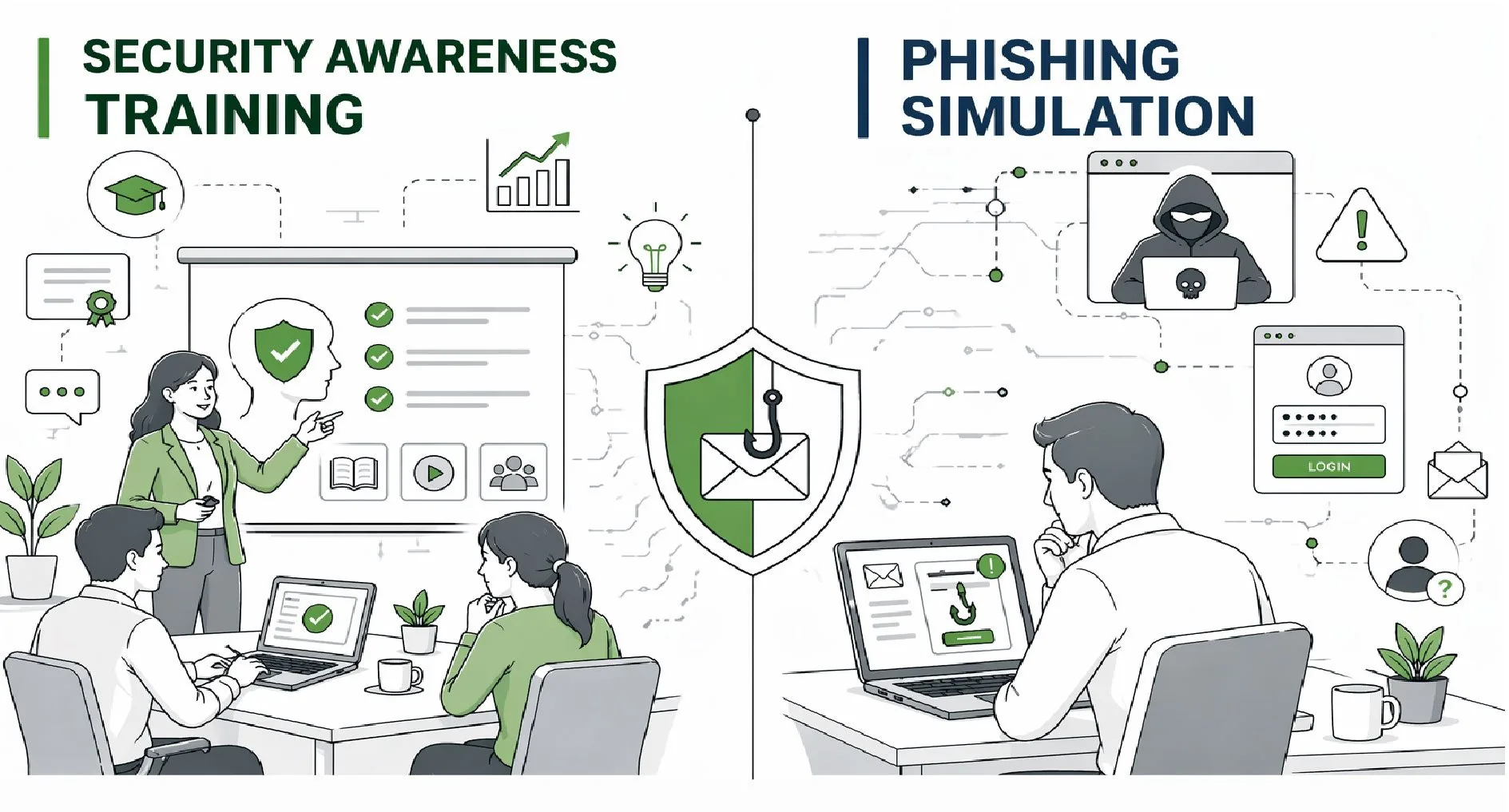
The Question Every UAE SME Asks
A UAE business owner, HR lead, or IT manager gets asked by the board — or the auditor — to "do something about phishing." They get two options from us: Phishing Simulation or Security Awareness Training. And they ask a sensible question:
"Which one do we start with?"
The answer most consultants give is "both." That's not wrong, but it's not useful either. Here's a more practical answer based on what actually changes employee behaviour.
The Short Answer
Start with a phishing simulation — but only if you're prepared to run it again after training.
A single phishing sim without training is a one-time data point. A single training session without measurement is a compliance checkbox. The value is in the before / after comparison — baseline click rate, intervention (training), follow-up click rate, and then sustained measurement over 90 days.
Why Baseline First
Running a phishing sim before training gives you:
- An honest baseline. UAE SMEs we work with typically start with click rates between 18% and 35%. That's what you're working against.
- Concrete examples for the training. When 14% of your finance team clicked a fake invoice lure, the training writes itself.
- Board-consumable urgency. "33% click rate" gets attention. "We should do training" does not.
- Audit evidence. ISO 27001, NESA, and PDPL frameworks all benefit from documented baseline data.
If you train first, you're guessing at the problem. If you sim first, you know it.
The 30-60-90-Day Model
Here's the pattern that works for UAE SMEs (10 – 200 employees):
| Phase | Activity | Purpose |
|---|---|---|
| Week 0 | Baseline phishing sim (1 – 3 scenarios) | Measure current click rate, by role |
| Week 2 – 3 | Security Awareness Training (workshops, live demos) | Train with specific examples from baseline |
| Day 30 | Follow-up phishing sim | Measure immediate behaviour change |
| Day 60 | Second follow-up sim, different scenarios | Check decay |
| Day 90 | Third sim + summary report | Long-term retention measurement |
The typical result: click rates drop from 25 – 35% to 5 – 12% across this cycle. Finance teams show the biggest improvement; sales teams show the most decay.
What Each Service Actually Costs
For a typical UAE SME (30 – 100 employees):
- Phishing Simulation (single campaign, 3 – 5 scenarios): AED 8,000 – 20,000
- Security Awareness Training (workshops, 1 – 2 sessions): AED 8,000 – 25,000
- Combined program (baseline sim + training + 3 follow-up sims over 90 days): AED 30,000 – 55,000
The combined program is what most clients actually buy. Running just one half of it produces data; running both produces behaviour change.
When to Skip the Sim and Go Straight to Training
There are scenarios where starting with training makes sense:
- You've just had an incident. Click rate data is moot — everyone is sensitized. Train immediately while memory is fresh.
- Your compliance deadline is next month. Training is fast to schedule; phishing sims take 2 – 3 weeks.
- You're under 10 employees. Small sample sizes make click-rate metrics statistically meaningless. Direct training is more effective.
Otherwise: sim first.
Why This Combination Beats E-Learning Platforms
Most UAE SMEs have tried some form of e-learning — KnowBe4, Proofpoint, generic LMS phishing modules. The result is consistent: click rates drop briefly then return to baseline within 60 days.
The difference with our model is the live demonstration layer. Our workshops are delivered by the same people who run pen tests — when someone stands in front of your team and spoofs a Wi-Fi network live, or walks through a phishing kit they've used against real targets, the memory sticks in a way slide-click modules don't.
The Measurement Question
Without baseline data, you can't prove training worked. And without training, your baseline just tells you what you already knew: employees click. The value is in the delta — and that needs both halves.
Ready to get a baseline click rate for your organisation? Book a 30-minute scoping call. We can typically run a baseline sim within 2 weeks and have training scheduled by week 3.
