
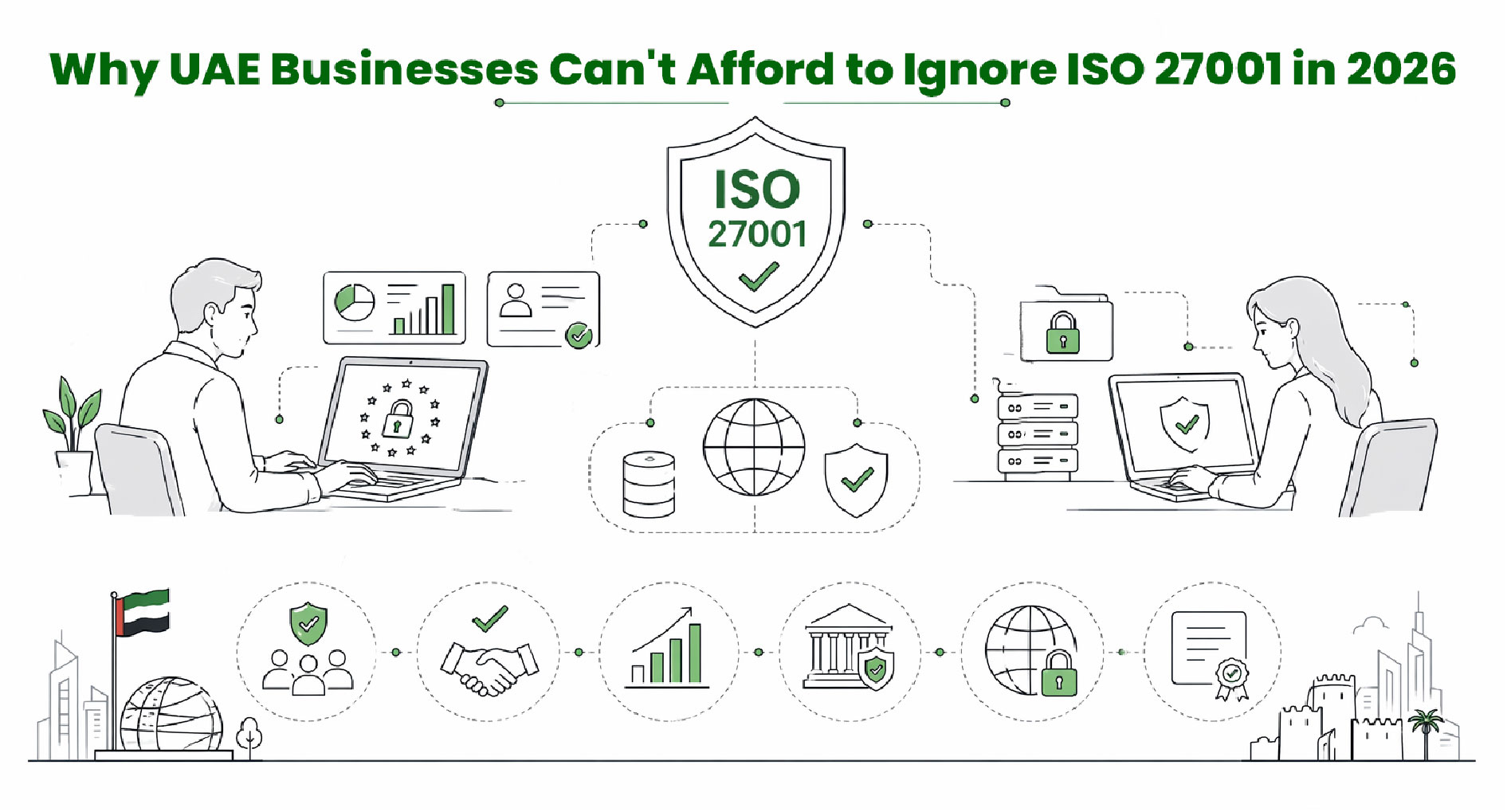
What Is ISO 27001 — In Plain English?
Think of ISO 27001 as a rulebook for keeping information safe. It is the world's most recognized standard for information security management. It tells your company exactly how to:
- Identify what data you have and where it lives
- Figure out what could go wrong (risk assessment)
- Put the right protections in place
- Keep improving those protections over time
It is not a piece of software you install. It is a system — a set of policies, processes, and controls that cover everything from how employees handle passwords to how your servers are backed up.
Why Does It Matter for UAE Companies?
1. The Law Is Getting Stricter
The UAE has introduced the Personal Data Protection Law (PDPL) under Federal Decree-Law No. 45 of 2021, which is now being actively enforced. Government entities like the Telecommunications and Digital Government Regulatory Authority (TDRA) and the UAE Cybersecurity Council are pushing businesses to adopt formal security frameworks.
If you handle customer data — names, emails, payment details, health records — you are expected to protect it. ISO 27001 gives you a proven framework to meet these expectations.
2. Clients Are Asking for It
Whether you work with government agencies, banks, healthcare providers, or international companies, you will increasingly hear this question:
"Are you ISO 27001 certified?"
Many procurement processes in the UAE — especially in Dubai and Abu Dhabi — now require vendors to hold this certification. Without it, you may lose contracts before you even get to pitch.
3. Cyberattacks Are Rising Across the Region
The Middle East is one of the fastest-growing targets for cybercriminals. Ransomware attacks, phishing scams, and data breaches hit businesses of all sizes. A single incident can cost you:
- Financial losses — ransom payments, legal fees, regulatory fines
- Reputation damage — customers lose trust and leave
- Operational downtime — your business grinds to a halt
ISO 27001 does not make you immune to attacks, but it dramatically reduces your risk and ensures you can respond quickly when something happens.
What Does Getting Certified Actually Involve?
Here is a simplified breakdown of the journey:
Step 1: Gap Analysis
A cybersecurity expert reviews your current setup and identifies what is missing. Think of it as a health check for your information security.
Step 2: Risk Assessment
You list out everything that could go wrong — data leaks, server crashes, employee mistakes, phishing attacks — and rank them by likelihood and impact.
Step 3: Build Your ISMS
ISMS stands for Information Security Management System. This is the heart of ISO 27001. It includes:
- Security policies (written rules everyone follows)
- Access controls (who can see what)
- Incident response plans (what happens when something goes wrong)
- Employee training programs
- Technical controls (firewalls, encryption, backups)
Step 4: Internal Audit
Before the official certification audit, you test everything yourself to make sure it works.
Step 5: Certification Audit
An accredited auditor (a third-party organization) reviews your ISMS. If everything checks out, you receive your ISO 27001 certificate.
Step 6: Continuous Improvement
ISO 27001 is not a one-time event. You undergo surveillance audits every year and a full recertification every three years. This keeps your security sharp and up to date.
Common Myths About ISO 27001
"It is only for large enterprises." Not true. SMEs across the UAE are getting certified. The standard scales to fit your business size.
"It is too expensive." The cost of a data breach is almost always higher. Many companies recover their certification investment within the first year through new contracts alone.
"We already have antivirus and a firewall — is that not enough?" Those are just two pieces of the puzzle. ISO 27001 covers people, processes, and technology. A firewall cannot stop an employee from emailing sensitive data to the wrong person.
How Underwings Can Help
At Underwings, we specialize in helping UAE businesses achieve ISO 27001 certification. Our approach is practical, not theoretical:
- Gap analysis to see exactly where you stand today
- Risk assessment tailored to your industry and operations
- Policy development — we write the documentation with you, not just hand you templates
- Employee training so your team understands their role in keeping data safe
- Audit preparation so you walk into your certification audit with confidence
Whether you are a startup in Dubai or an established company in Abu Dhabi, we will guide you through every step.
The Bottom Line
ISO 27001 is not just a certificate you hang on the wall. It is a competitive advantage, a legal safeguard, and a trust signal to every client and partner you work with.
In a market where data breaches make headlines and regulations are tightening, the question is not "Should we get certified?" — it is "Can we afford not to?"
Ready to start your ISO 27001 journey? Contact us for a free consultation.